Runtime safety, auditability and management

Operational Infrastructure for Agents in Production

MeaningStack gives ML, DevOps, Security, and Compliance teams real-time visibility into agent reasoning and the ability to intervene before actions execute. Prevent incidents, debug failures fast, and prove compliance with a complete runtime audit trail.

Why Agents Break Traditional Governance

Agents make decisions continuously, in complex environments, at machine speed. Post-hoc audits and static guardrails weren’t built for systems that reason, call tools, and act autonomously in production.

Post-Audit Gap

Issues Found After Impact

Reviews catch problems only after actions have executed—after customers, data, or systems are already affected. Agent governance has to happen before outcomes, not months later.

Operational Gap

Humans Can’t Keep Up

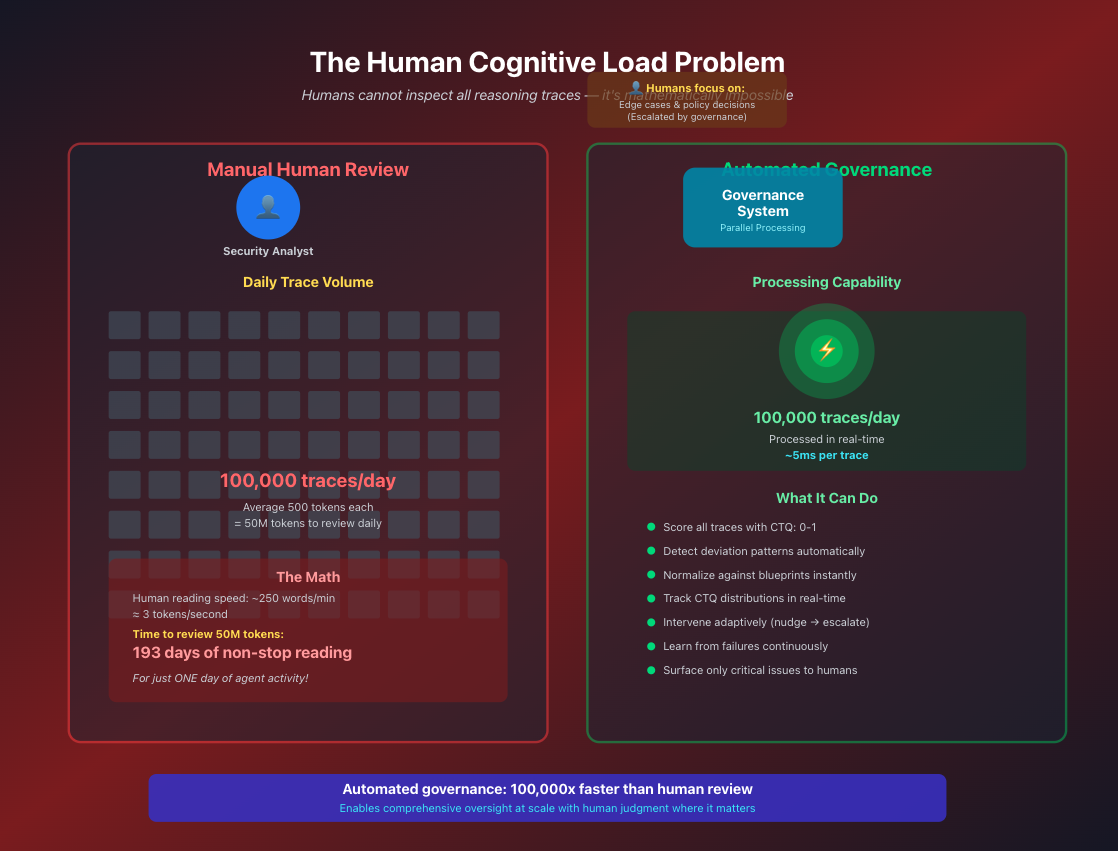
DevOps and ML teams can’t manually review thousands of agent decisions a day. Without automated oversight, you’re forced to choose between bottlenecks or blind spots.

Visibility Gap

No Reasoning Visibility

Inputs and outputs don’t show why an agent acted. Failures happen inside the reasoning loop—tool choice, assumptions, missing checks. If you can’t see reasoning, you can’t govern it.

Continuous evaluation, Evidence-based intervention, Compounded learning

Monitor AI reasoning as it unfolds. Intervene when needed. Scale oversight to risk.

🛡️

Steward Agents™

Runtime monitors that score reasoning quality as agents plan and act. Detect missing checks, unsafe assumptions, and policy deviations before tool calls or external actions execute.

📋

Governance Blueprints

Encode your policies, constraints, and required checkpoints in machine-readable form. Agents can operate autonomously inside clear boundaries you define.

👤

Human-in-the-Loop

Escalate only the decisions that matter. Complete context, confidence scoring, and graded controls (allow, nudge, block, or route to approval).

🔒

Governance Ledger

A complete, searchable ledger of reasoning traces, checks, interventions, and outcomes. Reconstruct any decision for incident response or regulatory audits.

The MeaningStack Difference

Oversight That Scales to Risk

Adaptive oversight that adjusts intensity based on actual risk—no blanket surveillance, no bottlenecks.

Ultra-Light for Low Risk
Customer queries, routine tasks
🎯
Deep Analysis for High Stakes
Financial transactions, healthcare decisions
🔄
Adapts Automatically
No manual tuning required

Govern Reasoning by Defining the Terrain

Agents navigate the world using internal mental maps. Blueprints ensure those maps match your real operational topography.
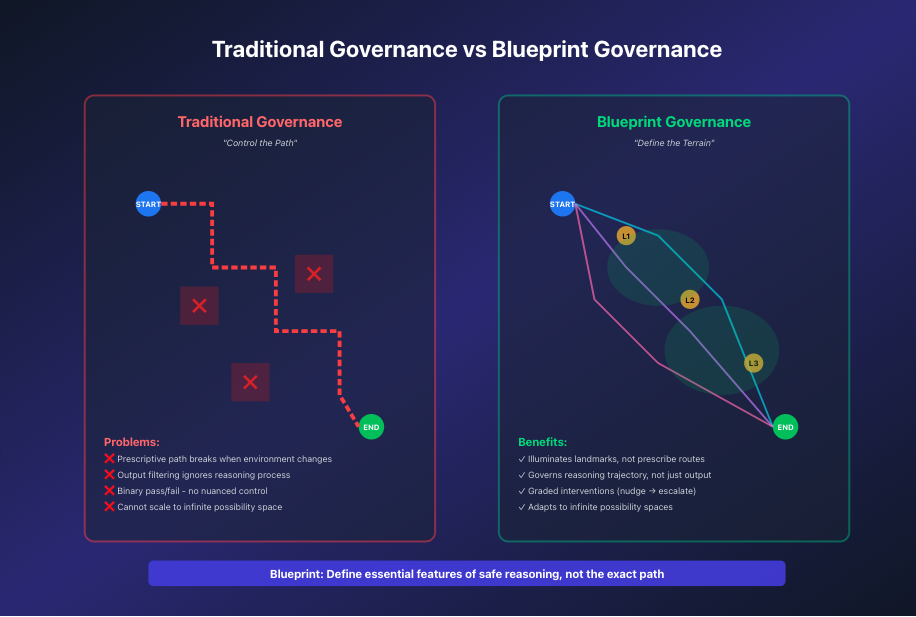
Traditional Governance vs Blueprint Governance

Every agent, when it acts in the world, is operating on a mental map — a topography the model constructs about what matters, what is risky, what must be checked, and how tools should be used. But that map is fragile, incomplete, and sometimes wrong.

MeaningStack provides enterprise‑grade Blueprints that define the checkpoints that legally matter, the comparisons that must be made, the steps that cannot be skipped, and the relationships that must hold. Blueprints don’t prescribe exact routes — they illuminate the landmarks of safe reasoning so agents can act autonomously inside clear boundaries.
Are your AI agents aware of your "Enterprise Operational Topography" and how it evolves?

What we solve for

The Challenging Reality of Deploying Agents at Scale

At scale, agents introduce failure modes you can’t catch with tests or output filters.

🔧

Tool Calling Failures

Agents call the right tool for the wrong reason—hallucinating capabilities, skipping preconditions, or chaining tools without validating intermediate states.

💸⏱️

Token Budget + Latency Drag

Agents can spiral into long reasoning loops, retries, or redundant tool calls—quietly exploding token costs. At the same time, uniform oversight adds latency to every step, compounding into slow UX, timeouts, and brittle multi-agent chains.

👁️

Silent Reasoning Failures

Agents reach correct outputs through flawed reasoning—passing tests but failing in edge cases you never anticipated. Blind spots like skipped checks or hidden assumptions stay invisible until they cause incidents.

🧭

Blind Spot Failures

Agents operate on incomplete or incorrect internal maps—skipping required checks, making hidden assumptions, or hallucinating safe conditions. These blind spots rarely show up in outputs or logs but lead to high‑risk actions in production.

📊

No Trust Baselines

You can't measure trustworthiness or detect drift. When should you revoke trust? When has an agent left its competence zone?

Traditional approaches (manual review, output filtering, batch testing) weren't designed for autonomous reasoning at scale

Built for High-Stakes Production

Where agent reliability directly impacts business outcomes.

Financial Services

Payment processing, fraud detection, and risk assessment. When agents handle money, reasoning integrity is non‑negotiable.

Healthcare

Clinical decision support and patient coordination. Agent reliability is patient safety and liability control.

Enterprise Operations

Multi‑agent workflows, automation, and A2A coordination. Small reasoning errors cascade into major operational failures.

E‑commerce

Customer‑facing agents, inventory decisions, and dynamic pricing. Reliability protects trust and margin.

Integrate Fast. Govern Continuously.

1

Define Your Operational Map

Define policies, constraints, and required checkpoints as Governance Blueprints.

2

Integrate Steward Agents

Zero code changes. No model retraining. Oversight from day one.

3

Monitor & Intervene

Real-time alerts when reasoning quality degrades. Intervene before actions execute.

4

Learn & Adapt

Build trust baselines from evidence. Governance improves continuously without the need for manual tuning.

Agents are powerful—but without cognitive visibility & speed to review at scale, they’re risky to operate in production.

When agents generate tens of thousands of reasoning traces per day, manual review becomes impossible. Humans Can’t Handle Production Scale aloneGovernance must be automated.

The Human Cognitive Load Problem

The First Real-Time Cognitive Governance Layer

Observability shows outcomes. Guardrails filter content. Compliance platforms audit history. MeaningStack governs reasoning in real time—before decisions become actions.

Solution Category
Approach & Key Limitations
AI Observability Tools
Monitor model performance post-deployment.
Missing: Real-time reasoning oversight during decision-making.
Guardrail Providers
Content filtering at model level.
Missing: Reasoning transparency and adaptive intervention.
Compliance Platforms
Post-deployment audits and documentation.
Missing: Runtime intervention when it matters.
MeaningStack NEW CATEGORY
Real-time cognitive governance with human-in-the-loop oversight.
Complete reasoning visibility. Graded interventions. Scales to risk. Model-agnostic infrastructure layer.

We're creating a new category: Operational Agent Governance—the infrastructure layer that makes autonomy and trust coexist at scale.

Our product

Production Ready
Enterprise deployments validated in high-stakes workflows
🏥
Healthcare Validated
68 emergency triage simulations
⚖️
Patent-Pending
US & NL filings for cognitive governance architecture
🤝
Enterprise Pilots
Deployments in negotiation with EU institutions

Built on Open Standards

Built on the Cognitive Governance Protocol (CGP), an open standard for governing agent reasoning across models and stacks.

🔓

Open Protocol

Transparent specifications anyone can verify and audit. No proprietary black boxes.

📄

Documentation

Complete technical guides for implementation and integration.

🎓

Research & Validation

Collaborating with AI Safety Camp. Validated in healthcare and enterprise production.

Have Questions?

View our FAQ →

Ready to Deploy Agents You Can Trust?

MeaningStack enables you to safely deploy autonomous AI in production—with the visibility, control, and accountability your organization demands.